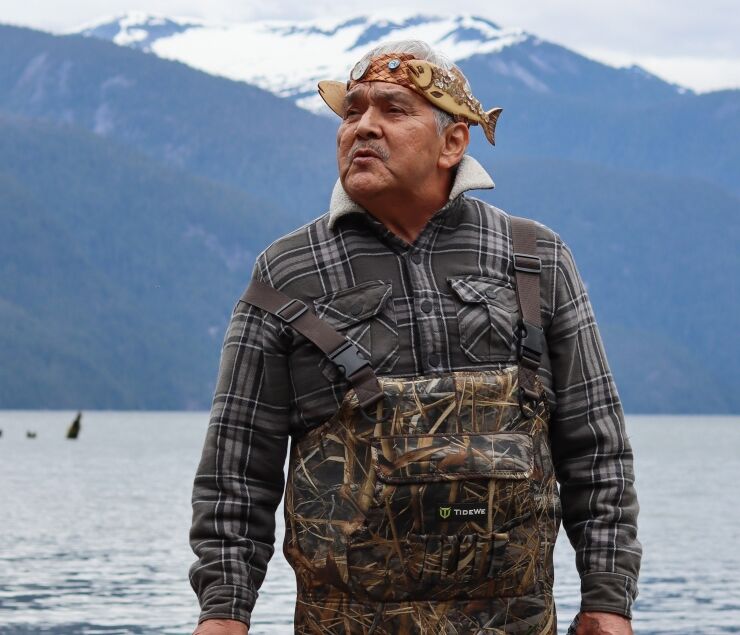
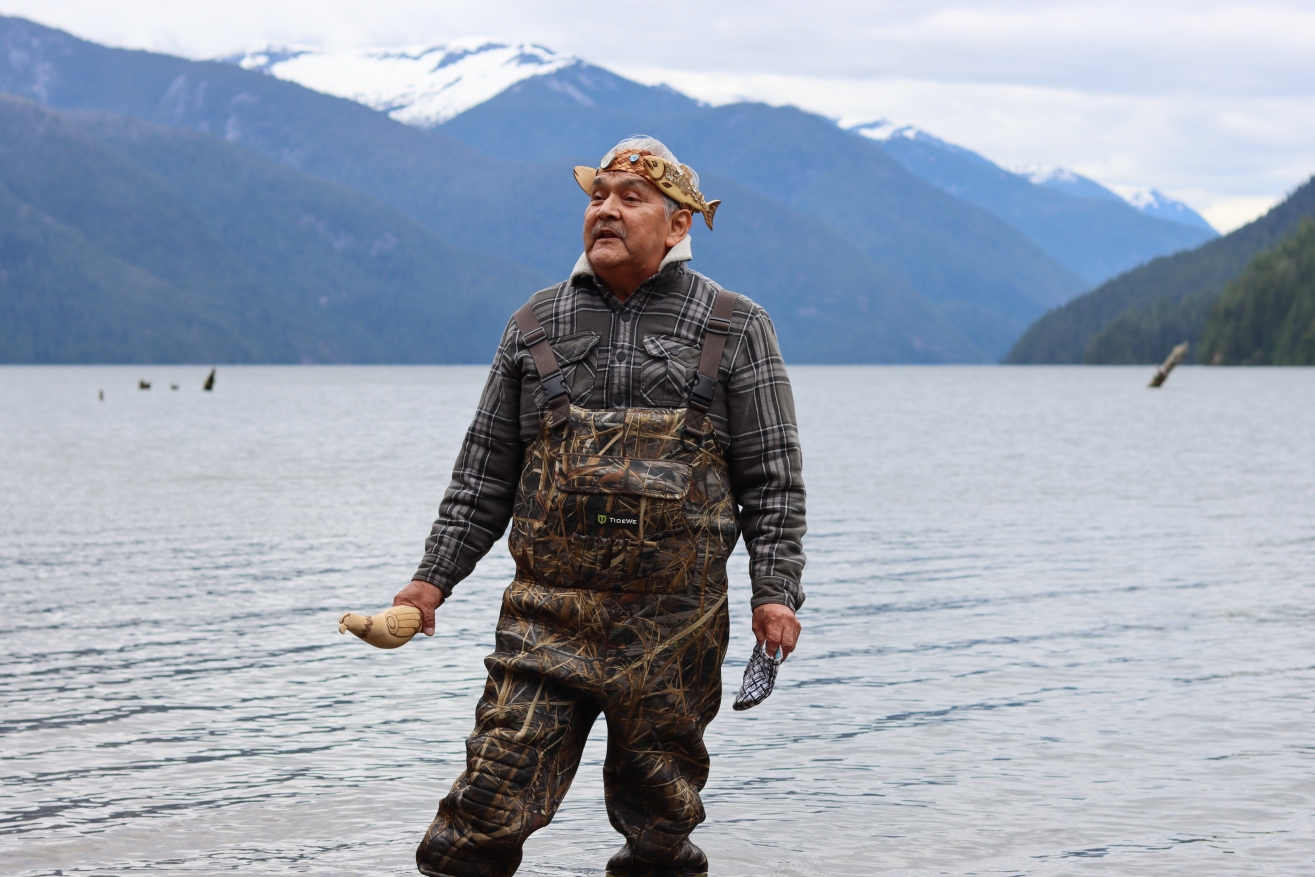
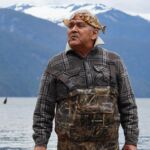
Elder and Knowledge Holder, George Johnson, performs a water blessing ceremony at ‘Wuìk̓inux̌v Lake near Rivers Inlet, British Columbia. (Photo: Logan Griffiths / Coast Funds)
Through stewardship led by rich cultural traditions and ancestral knowledge, ‘Wuìk̓inux̌v Nation is working to restore balance for salmon, the Rivers Inlet watershed, and future generations.
Rivers Inlet is the main community of ’Wuìk̓inux̌v Nation, located at the mouth of the Rivers Inlet fjord and adjacent the Waànuxv Wannock River.
At a Glance
’Wuìk̓inux̌v’ Wuikinuxv Nation combines traditional knowledge, stewardship, and community-led action to restore salmon and strengthen its territory. Through their community-focused trout derby and creekwalking programs, the Nation restores balance to its watershed while strengthening food security, revitalizing culture, and reconnecting its citizens with their lands and waters. Elders, Knowledge Holders, Guardians, and stewardship staff work together, drawing on traditional knowledge to support modern research practice, passing on cultural teachings to future generations.
Community Trout Derby
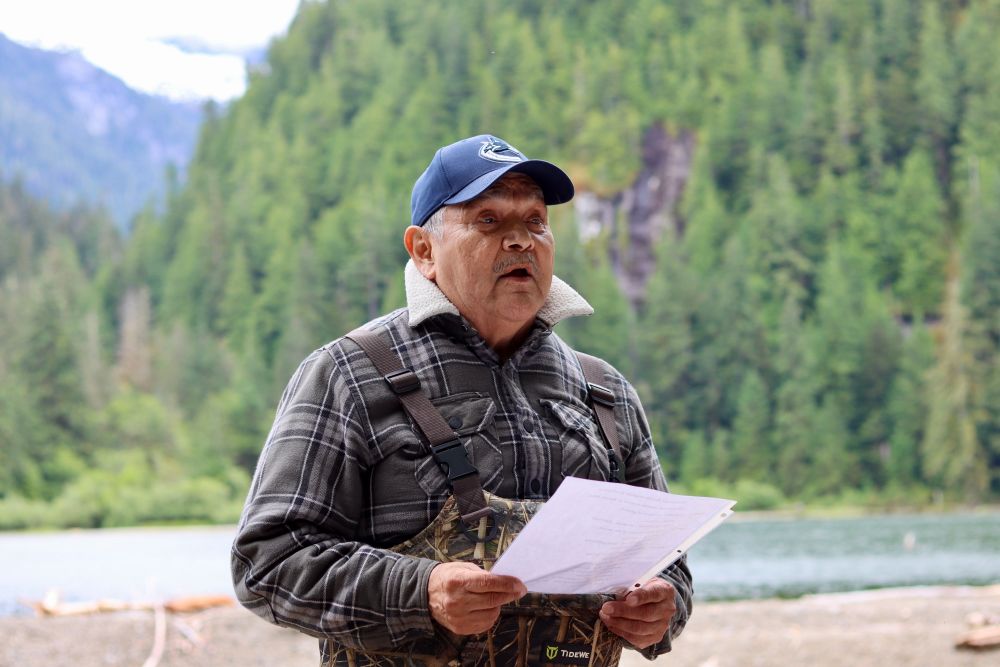
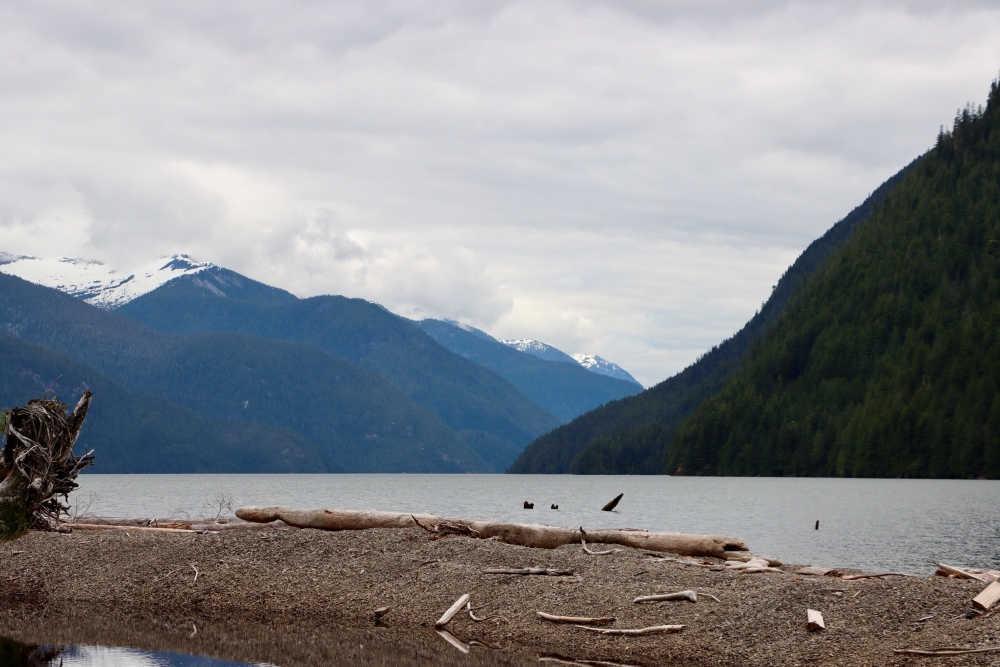
’Wuìk̓inux̌v Elder and Knowledge Holder, George Johnson, stands on the banks of ‘Wuìk̓inux̌v Owikeno Lake with a sheet of paper in his hands. Behind him, cedar-covered mountains rise high above the waters of Rivers Inlet and Waànuxv Wannock River, their snow-capped peaks reflected in the still lake below.
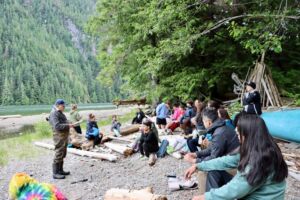
Community members gather on the shoreline of w̓ùbis, known locally as Crown Road. Today, around 100 ‘Wuìk̓inux̌v citizens live year-round at the village of K̓itit. The village is growing again, with young people moving home – eager to learn the traditions of ‘Wuìk̓inux̌v Elders, like George. (Photo: Logan Griffiths / Coast Funds)
Around him, more than 30 ‘Wuìk̓inux̌v community members gather along the shoreline of w̓ùbis, known locally as Crown Road. Children perch on driftwood logs while parents prepare fishing rods for an afternoon by the water.
George glances down at his paper and searches for the next ’Wùik̓ala word on his list.
“Repeat after me: maìkəm. That’s the ’Wùik̓ala word for spring salmon.”
A chorus of voices repeat the word back to him. George smiles before pointing to the next word on the page.
“And then we have, ǧvùlisdi,” he continues. “That’s the word for trout.”
His teachings are not just about language. Today, George is joined by staff from the ‘Wuìk̓inux̌v Stewardship Department, who have invited community members of all ages to take part in the Nation’s annual trout derby. Fishing gear and snacks for the kids are ready for today’s derby, which brings family and friends together while supporting ‘Wuìk̓inux̌v’s long-term efforts to restore balance to the ecosystem.
Elder and Knowledge Holder, George Johnson, shares ’Wùik̓ala words for a variety of trout and salmon species, seasons, and plants. As a Knowledge Holder, George works closely with other Knowledge Holders and Elders at ‘Wuìk̓inux̌v’s Kitit Culture Centre to ensure the ’Wùik̓ala language is correctly recorded and written. (Photo: Logan Griffiths / Coast Funds)
George gestures at the calm water behind him.
“Trout are predators to salmon,” he explains. “What trout are doing is reducing our food sources. That’s why we have the derby, so that we can help balance the situation out.”
For ‘Wuìk̓inux̌v people, salmon are more than a fish. They are vital to the Nation’s food security, culture, and way of life, while also sustaining the rivers, forests, and coastal ecosystems that have supported untold generations.
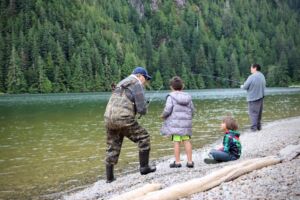
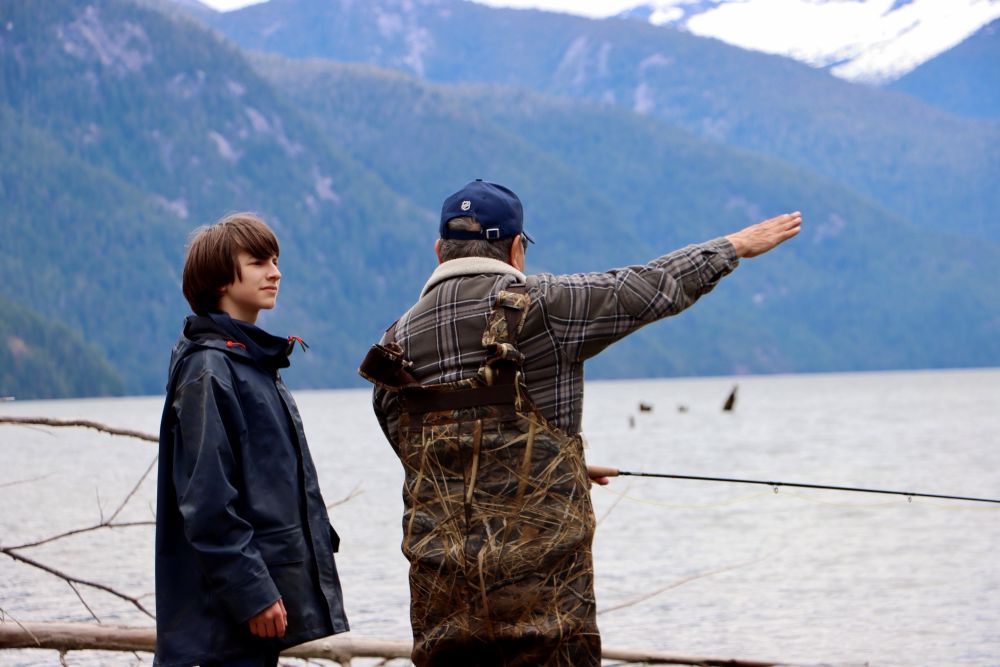
Elder and Knowledge Holder, George Johnson, teaches youngsters how to cast a fishing line into ‘Wuìk̓inux̌v Lake. Before colonization, ‘Wuìk̓inux̌v people lived in harmony with nature and had developed a sophisticated system of techniques for hunting, fishing, and harvesting. Their knowledge of their environment, successfully handed down to each generation, was complete. (Photo: Logan Griffiths / Coast Funds)
Raven Walkus, in her capacity as Salmon Restoration Coordinator, has researched the way her ancestors managed predators to salmon before European settlement. Much of her research has involved listening to Elders like George share their knowledge passed down from generation to generation.
“Trout was harvested historically by ‘Wuìk̓inux̌v as a way to control and reduce that predatory pressure on salmon,” she explains. “The trout eat the baby salmon as they are coming up out of the gravel.”
Trout also eat salmon eggs, George adds. “That’s what we try to protect, so that we’ll have more sockeye, because when trout over-eat them, it’s cutting back on our catch, the bears’ catch, and the catch of all other predators of salmon.”
As George finishes speaking, the crowd makes its way toward the shoreline. Parents help children fasten hooks while others cast their lines into the lake.
By supporting the harvest of trout, the derby brings balance in ‘Wuìk̓inux̌v’s watershed ecosystem, giving the salmon a better fighting chance while strengthening community connections to traditional harvesting practice.
“It’s all about the balance,” he says.
Elder and Knowledge Holder, George Johnson, demonstrating techniques for flyfishing. Traditionally, ‘Wuìk̓inux̌v people used bone-hooks, spears, traps, weirs, and fibre nets to catch fish. (Photo: Logan Griffiths / Coast Funds)
A Lake that Once Overflowed with Salmon
Located at the head of Rivers Inlet on British Columbia’s central coast, ‘Wuìk̓inux̌v’s territory stretches from Koeye River to Cranstown Point and inland to ‘Wuìk̓inux̌v Lake. For thousands of years the Nation has relied on these lands and waters for food, culture, and identity, and upheld a responsibility to care for the territory and ensure its abundance for future generations.
That abundance is still vivid in Colin Shaw’s memory. As a child, he remembers swimming through schools of salmon so dense their tails and fins brushed against him as they surged upstream to spawn.
“The waters here had so many fish that they would be black with fish,” he recalls. “So many salmon used to come up, that sometimes the fish underneath would push the fish on top, literally like it was boiling.”
Traditionally, when the salmon return to their spawning grounds in the creeks and rivers flowing into ‘Wuìk̓inux̌v Lake and Rivers Inlet, ‘Wuìk̓inux̌v fishers would use fish traps made of stone and weirs built of cedar and hemlock poles to catch them. While salmon remains the main traditional food source for ‘Wuìk̓inux̌v Nation, their people also harvested cod, halibut, eulachon, herring, clams, mussels, seaweed, seals, sea otters, and more. Harvesting was undertaken using sophisticated techniques to ensure ecosystem balance was maintained and abundance was guaranteed for future generations. (Photo: Logan Griffiths / Coast Funds)
Colin spent much of his early childhood along the rivers and lakes of ‘Wuìk̓inux̌v territory, where daily life revolved around the water. Fishing, hunting, and travelling by boat were part of everyday life. Much of what he learned came from spending time with family members and Elders.
“I remember being [almost] two years old in what used to be a tiny village,” Colins recalls. “We never had running water and power was only on for a certain amount of time every day. All our drinking water, bath water – everything – was packed up in buckets from the river.”
As a youth, Colin was always “chomping at the bit” to go fishing or hunting. He often spent hours one-on-one with Elders and Knowledge Holders on the lake or deep in the surrounding mountains.
Every year, Rivers Inlet sees over 200 days of measurable precipitation. It is surrounded by glacial mountains that feed into the temperate rainforest and watersheds, providing nutrients to the diverse animal and plant life in ‘Wuìk̓inux̌v territory. (Photo: Logan Griffiths / Coast Funds)
For much of the twentieth century, the Rivers Inlet watershed supported one of British Columbia’s largest sockeye salmon runs, with annual returns reaching into the millions. Each year, salmon returned to ‘Wuìk̓inux̌v Lake, nourishing forests, wildlife, and the people who depended on them.
“I don’t ever remember there being a day where I didn’t walk up that river with a rod and come back with three, or four, or 10 fish for dinner,” says Colin. “But now, no such thing.”
Even during Colin’s youth, the impacts of industrial development were becoming apparent. By this time, commercial canneries had operated throughout ‘Wuìk̓inux̌v territory for decades, capitalizing on the region’s salmon abundance. By the end of the 19th century, 16 canneries were operating in Rivers Inlet.
Decades of habitat destruction, overfishing, and climate change negatively impactedsalmon returns across British Columbia, resulting in the collapse of some salmon populations. By the late 1990s, salmon harvest rates in some areas of British Columbia fell to 0.1 per cent of historic levels and the knock-on effects continue to devastate salmon numbers in 2026.
Today, about half of Pacific salmon populations remain in decline. For community members like Colin, those changes unfolded within a single lifetime.
“Now, when I go fishing, it’s like a desert.”
For the ‘Wuìk̓inux̌v Nation, the loss of salmon has greatly reshaped daily life in community and directly affected food security, making it more difficult for families to remain in community and harvest traditional foods. Today, there are 300 citizens of the ‘Wuìk̓inux̌v Nation, with fewer than 100 able to reside in the territory year-round.
“The state of our ‘Wuìk̓inux̌v salmon remains critical and uncertain,” explains Raven. “Our Elders continue to tell us that salmon populations have steadily declined.”
Although some Central Coastsalmon experienced record returns in 2025, one strong season does not indicate long-term recovery.
“That one good year does not mean that our salmon have recovered,” she says. “Our Elders and Knowledge Holders continue to share with us their experiences and stories about how abundant salmon and other resources used to be when they were kids. We continue to use information like this to identify new and different ways of determining abundance.”
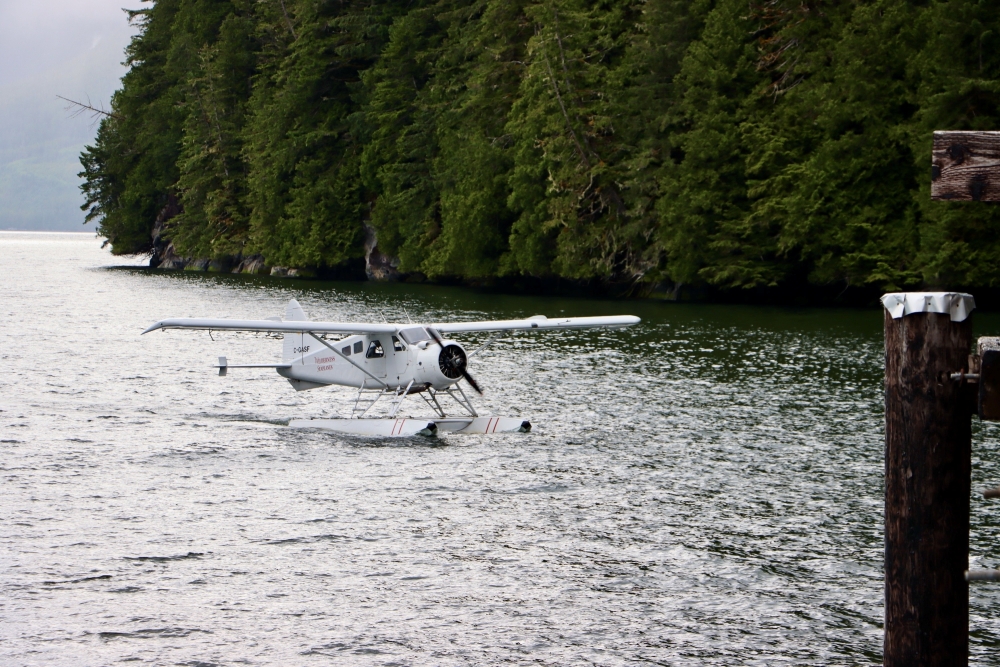
K̓itit Village, located in the heart of ‘Wuìk̓inux̌v Territory, lies 150 kilometres from Port Hardy and is accessible only via plane or chartered water taxi. Many aspects of life in K̓itit Village are expensive and challenging – from grocery shopping, to repairing household appliances and machinery, to accessing regular healthcare. (Photo: Logan Griffiths / Coast Funds)
Elders’ and Knowledge Holders’ observations help identify changes that cannot always be captured through modern scientific monitoring alone. While Western science provides one way of measuring and understanding environmental changes over time, the community’s stories and memories help guide ‘Wuìk̓inux̌v’s stewardship team in the right direction.
George has witnessed other changes in his territory.
“I used to come home with 10 or 12 trout easy,” he says. “We never used to have algae on rocks. The warmth of the water is causing the algae. Climate change is affecting us.”
“The algae sucks all of the oxygen out of the water,” adds Colin. “It creates a big die-off of insects, plants, and everything that fish feed on.”
These observations do more than document change. They also help shape the work ‘Wuìk̓inux̌v undertakes to restore salmon and strengthen connections between people and place.
Restoring More than Salmon
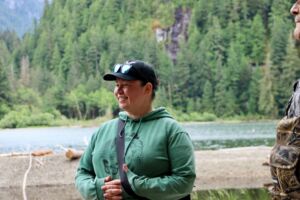
Salmon Restoration Coordinator, Raven Walkus, works for the ‘Wuìk̓inux̌v Stewardship Office on salmon and habitat restoration, harvesting trips, culture camps, surveys, and more. (Photo: Logan Griffiths / Coast Funds)
Salmon restoration is one part of a large body of work for the ‘Wuìk̓inux̌v stewardship program. With a small team of stewardship staff and Guardians, the program supports a range of initiatives that help care for the territory. Alongside salmon restoration, the team runs culture camps, creekwalking and harvesting programs, builds community cabins, and provides equipment and fuel that help community members access the territory.
Each program targets ‘Wuìk̓inux̌v Nation’s broader stewardship priorities. Some programs strengthen cultural priorities, while others improve food security and directly support the recovery of salmon populations.
Responding to the impacts of colonization, industrial fishing, habitat loss, and climate change, the stewardship team delivers several programs to target salmon recovery. Among them is the trout derby, which forms part of ‘Wuìk̓inux̌v’s broader salmon reconciliation and restoration efforts.
“For us, salmon stewardship is about so much more than protecting a species,” says Raven. “It’s about protecting who we are as ‘Wuìk̓inux̌v and that includes our culture, our food systems, our environment, our history, and our relationships with our lands, waters, and territorial relatives.”
Every year, the stewardship team also runs a creekwalking program to monitor salmon populations and collect data on returning species. This work was once carried out by the Department of Fisheries and Oceans Canada (DFO) but was recently reclaimed by ‘Wuìk̓inux̌v.
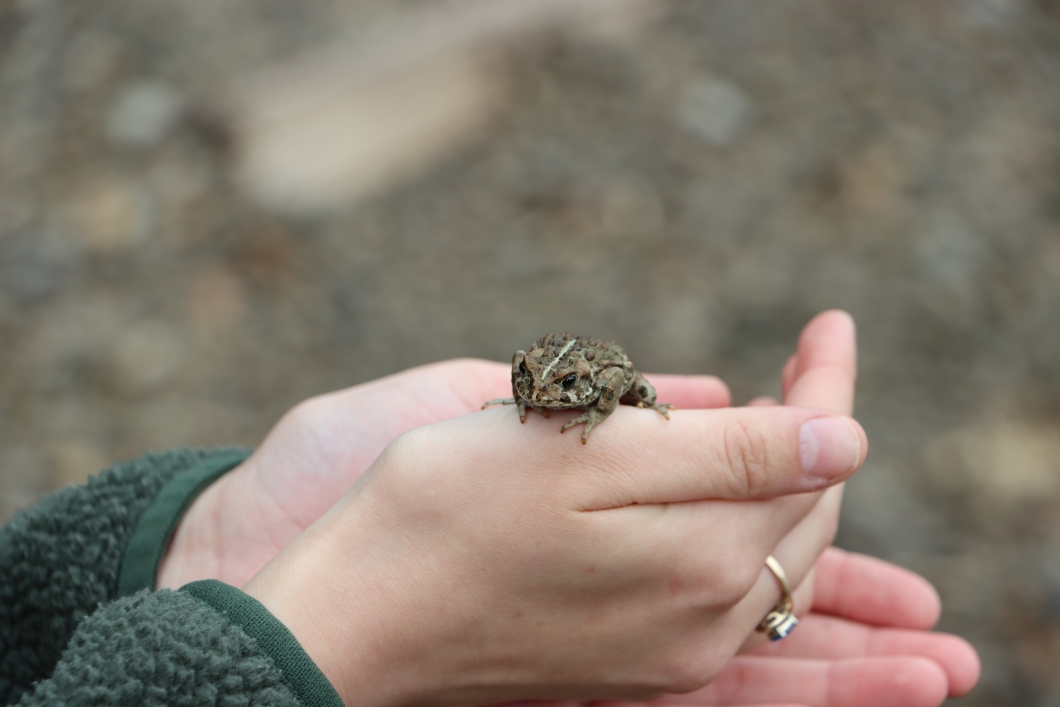
Wuìk̓inux̌v territory is home to diverse wildlife, including a healthy population of grizzly bears, mountain goats, elk, deer, marine mammals, and frogs. An important indicator species, frogs signal the health of an ecosystem. (Photo: Logan Griffiths / Coast Funds)
“We prioritize hiring ‘Wuìk̓inux̌v citizens on our crew each year and encourage short-term participation from community members who are unable to commit to the entire season.”
The flexible, community-led program gives Wuìk̓inux̌v people opportunities to reconnect to their territory, spending quality time on their land and in their waters while monitoring salmon spawning creeks.
It’s all about the balance
“Determining how our lands and waters are stewarded is essential to rebuilding our connections,” explains Raven. “Revitalizing our traditional stewardship and knowledge-transfer systems supports the health of our watershed and our community. Our teachings tell us that when we care for our environment, our environment cares for us. Stewardship is a cultural, social, spiritual, and environmental responsibility.”
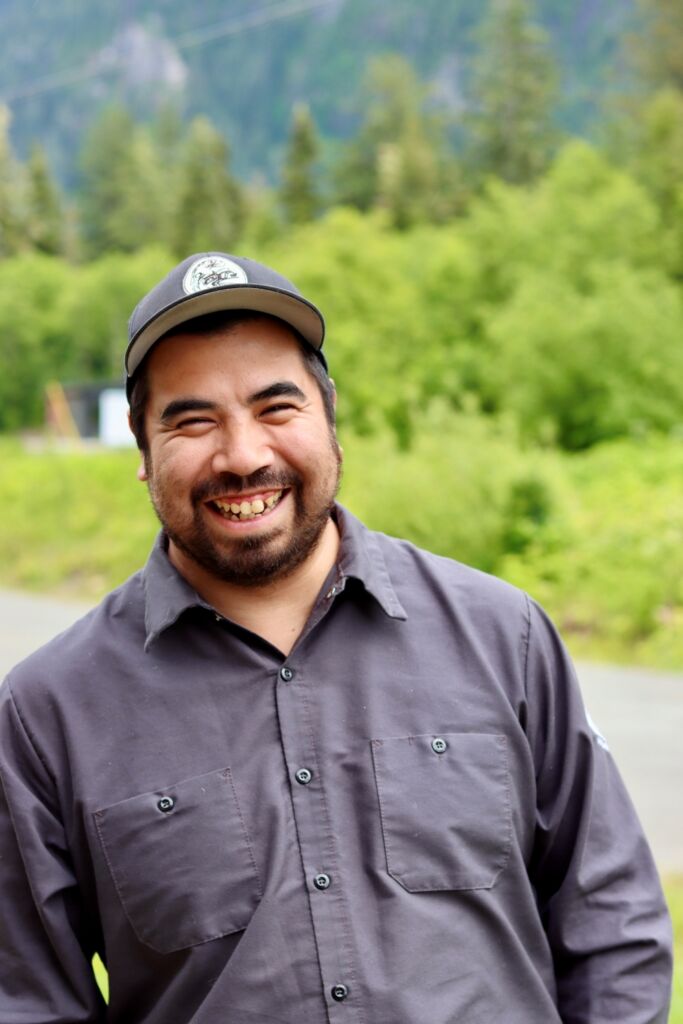
Guardian Adam Nelson lives in K̓itit Village with his young daughter. A Guardian for over seven years, he is dedicated to restoring ‘Wuìk̓inux̌v’s shorelines and caring for the beautiful wilderness and wildlife in his territory. Guardians act as the vital first responders for ‘Wuìk̓inux̌v territory. When a large diesel spill threatened Rivers Inlet, ‘Wuìk̓inux̌v Guardians arrived days before government agencies, safely containing 90 per cent of the spill and protecting culturally and ecologically vital estuaries like Kilbella Bay. (Photo: Logan Griffiths / Coast Funds)
Together, the creekwalking program and trout derby show how ‘Wuìk̓inux̌v approaches stewardship as both ecological restoration and cultural revitalization, creating opportunities for community members to reconnect with the land, harvest traditional foods, and share knowledge across generations.
“This holistic approach reflects our belief that healthy ecosystems and healthy communities are a priority,” says Raven. “And that ‘Wuìk̓inux̌v is best positioned to determine how our lands and waters are cared for.”
For ‘Wuìk̓inux̌v Guardian Adam Nelson, stewardship is both an inherent responsibility and a way of strengthening his connection to culture, family, and his territory.
“What’s important is the connection with where I’m from and hearing the stories from the Elders on what they give, the purpose of this area, and the family ties to it,” he says. “It’s important to be able to self-sustain, especially for yourself, because it’s a very isolated community.”
In a remote community, that responsibility extends beyond protecting salmon. It also means ensuring future generations can continue accessing their lands and waters.
“What I do is a huge privilege because a lot of Elders, a lot of members, a lot of people don’t get to see what we see every single day. I try to be as grateful as I can, and I try to uphold that big responsibility of being a Guardian.”
Knowledge Carried Forward
While stewardship programs help restore salmon populations, they also create space for the sharing of knowledge between generations.
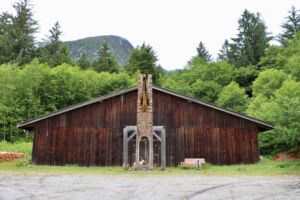
Built in 2005, Nuùw̓aqawa Big House is a source of strength and pride to ‘Wuìk̓inux̌v Nation, contributing to the revival of their potlatch laws and other important traditions. ‘Wuìk̓inux̌v Nation’s winter ceremonial dances are recognized across the coast, rooted in the knowledge of their Elders, language keepers, and artists who ensure ancestral names, songs, and traditions are carried into the next generation. (Photo: Logan Griffiths / Coast Funds)
Back at the trout derby, George leads a group of youth to the edge of ‘Wuìk̓inux̌v Lake. Standing beside the still water, he points across as he begins explaining how his ancestors harvested salmon and trout long before modern day rods and reels were used.
“There are all different ways of catching trout: not just rod and reels but also nets and weirs.”
For generations, ‘Wuìk̓inux̌v people built fish weirs throughout ‘Wuìk̓inux̌v Lake and Waànuxv Wannock watershed to sustainably trap and harvest salmon and trout. Designed to guide fish into holding areas without harming them, the structures allowed harvesters to select what they needed while releasing the remaining fish, helping sustain healthy fish populations.
“If you fly over Wannock River, on the rapids you’ll notice they have channels,” George says. “We used to have canoe channels, and we would put down a fish weir and trap them. [Our ancestors] would catch trout, eulachon, and all different types of salmon. That’s the old way of catching them.”
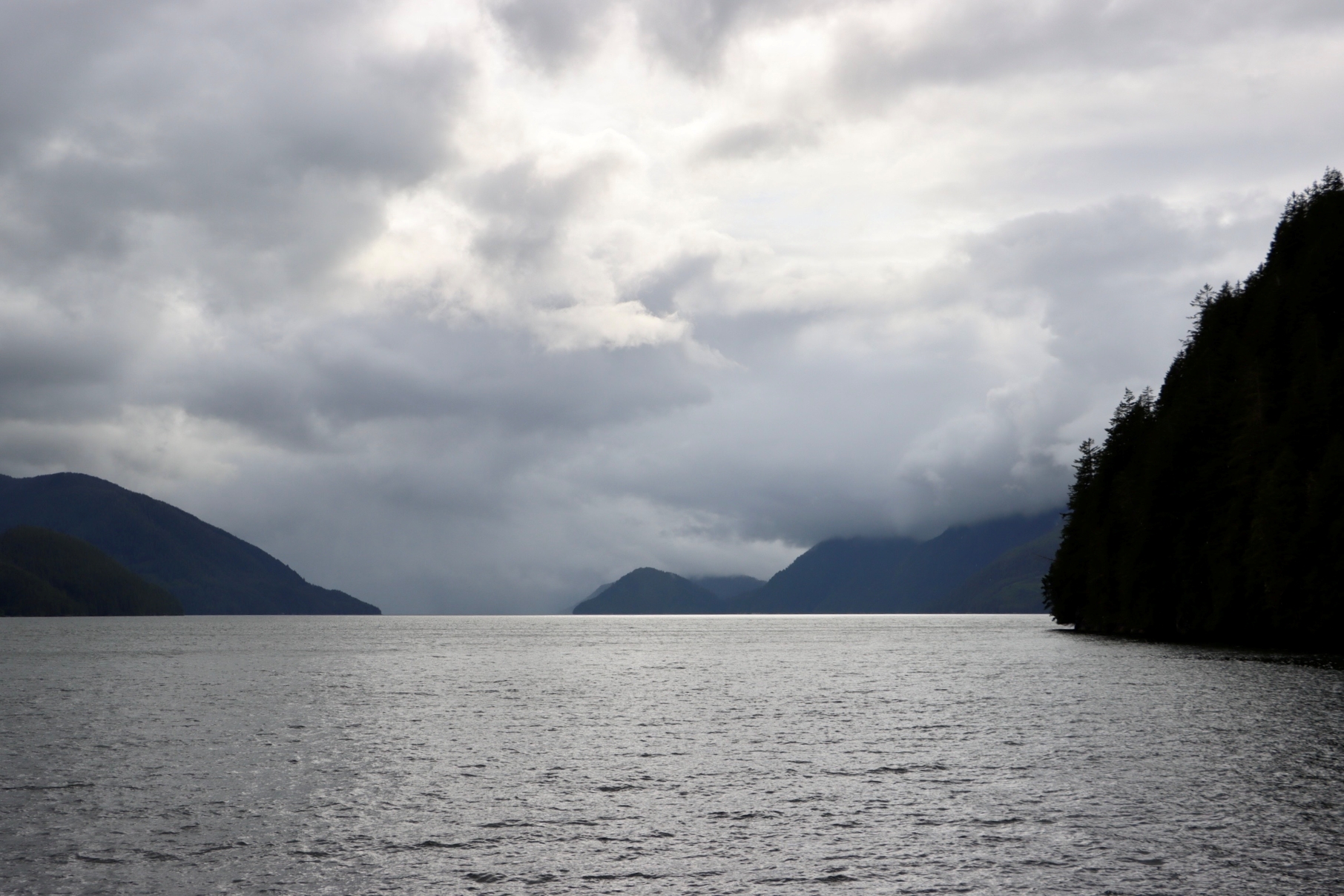
A view from the edge of K̓itit Village, looking out from Waànuxv Wannock River towards Rivers Inlet. Exercising their responsibility as caretakers of their lands and waters, ‘Wuìk̓inux̌v Nation collaborate with other Nations to establish Indigenous-led environmental protections, such as the Mia-yaltwa Ha’lidzogm hoon Indigenous Protected and Conserved Area (IPCA) and National Marine Conservation Area Reserve (NMCAR) established in collaboration with five other First Nations in the Great Bear Sea and Great Bear Rainforest. (Photo: Logan Griffiths / Coast Funds)
Although ‘Wuìk̓inux̌v no longer uses fish weirs, the holistic principles behind them continue to shape stewardship today. Following their ancestors’ teachings, stewardship staff like Raven and Adam focus on maintaining balance within the watershed rather than maximizing harvests.
“Historically, our people used to travel up and down the lake, seasonally, depending on what was available,” Raven explains. “Trout was an important food source when salmon populations were low.”
For George, passing on these teachings is deeply personal. Raised in ‘Wuìk̓inux̌v territory, he spent his early years living off the land with his parents and siblings, before being taken to residential school.
About 15 years ago, he returned home after his father came to him in a dream.
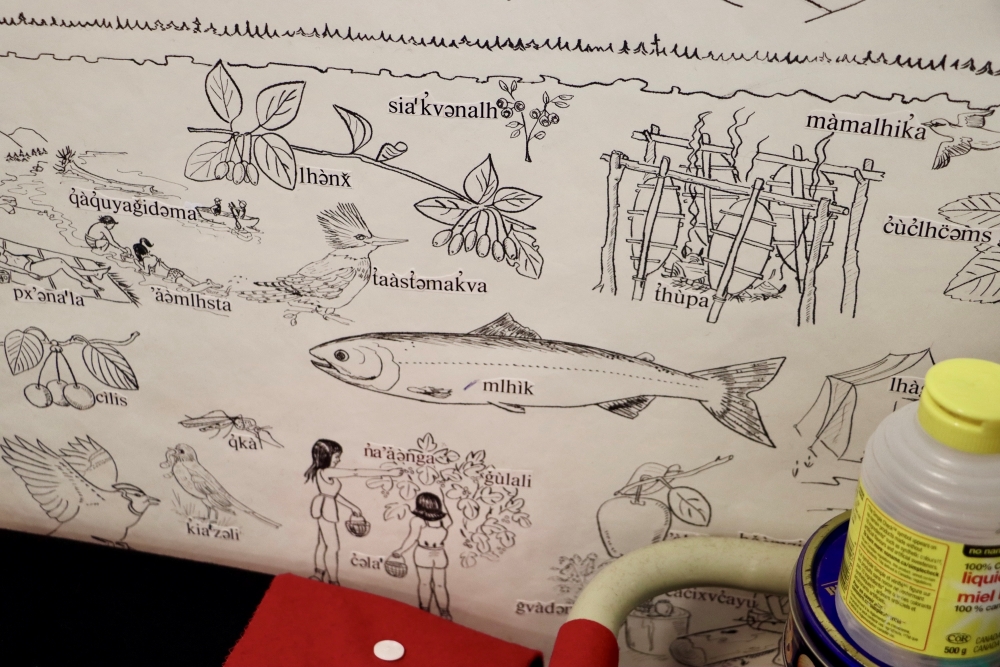
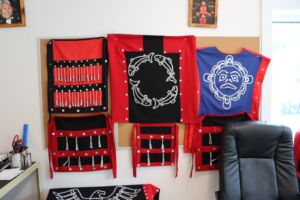
’Wùik̓ala language charts adorn the walls of the K̓itit Cultural Exchange and Tourism Centre. Using oral recordings and spoken word, ‘Wuìk̓inux̌v Knowledge Holders record and update ’Wùik̓ala language resources for the community. (Photo: Logan Griffiths / Coast Funds)Elders prepare regalia for a ceremonial dance. The regalia consists of shell-beaded patterns of salmon and the sun. Some regalia includes noise makers made of thin sheets of metal clamped in a cone shape on cord. (Photo: Logan Griffiths / Coast Funds)
“He’d come to me in my dreams,” George recalls. “He kept saying, ‘You have to be back home with your people.’”
Since returning home, George has dedicated himself to strengthening ‘Wuìk̓inux̌v language and culture. As an Elder and Knowledge Holder for the community, he helps document ’Wùik̓ala language and shares traditional knowledge and stories so future generations can continue to strengthen their connection to culture and ‘Wuìk̓inux̌v ways of being.
“I’m continually studying the language and history, it’s quite complex,” explains George. “I’m studying the part where it’s written in our language, but it wasn’t written down properly. I have to actually bring those sounds back.”
As George speaks, the children watch quietly, asking questions about the lake and the way fish were once harvested. Once the language lesson is complete, he prepares a water blessing.
“I’ve only been home 15 years,” he says. “I spent a long time running away from home.”
George steps knee-deep into the lake holding a pouch of featherdown.
“Featherdown is very sacred in our way of blessing the water. Featherdown brings peace to the water, so whatever’s in the water, it’ll help them survive or replenish.”
George explains his intentions in English before switching to ’Wùik̓ala.
“We need to shift the energy to assist what lives in the water, the salmon,” he explains. “All I do is just talk to the water. Energy is everything. It’s amazing. Energy is beyond us. We’re caring for the water, so the spirits care for us.”
When he sings, his voice is strong and unwavering.
Elder and Knowledge Holder, George Johnson, performs a water blessing ceremony at ‘Wuìk̓inux̌v Lake near Rivers Inlet, British Columbia. (Photo: Logan Griffiths / Coast Funds)
Contacts
Raven Walkus
Salmon Restoration Coordinator
‘Wuìk̓inux̌v Nation
George Johnson
Elder, Knowledge Holder
‘Wuìk̓inux̌v Nation
Through Coast Funds’ Conservation Fund, ‘Wuìk̓inux̌v Nation invested $800,000 in 2025 to support operations of the stewardship office, undertake research and management planning projects, and enhance their Coastal Guardian program.
Published On October 5, 2026| Edited On September 16, 2026
Sign up to receive the online edition of Talking Stick and discover inspiring stories, news, and updates from the Great Bear Rainforest and Haida Gwaii.