Estimated Reading time

6 Mins
Where Stewardship Meets Marine Response: Guardians Gather in K’ómoks Territory
Member First Nations of the Na̲nwak̲olas Council demonstrate marine response skills, capacity, and Traditional Knowledge at the Spring 2026 Guardian Gathering in K’ómoks territory.
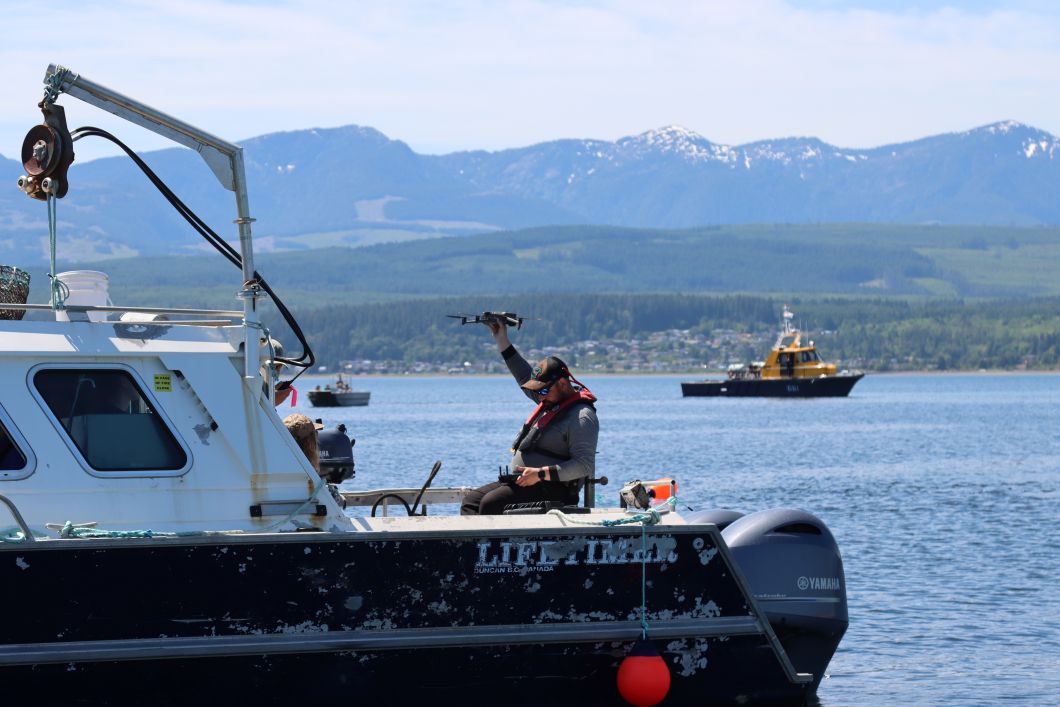
K’ómoks, Mamalilikulla, Tlowitsis, and We Wai Kai Guardians gathered in K’ómoks territory for the Spring Guardian Gathering, hosted by Na̲nwak̲olas Council in June.
Hosted at HMCS Quadra – a military barracks located on a natural breakwater known as Goose Spit in Comox Harbour – the Spring 2026 Guardian Gathering represented an important first partnership between K’ómoks First Nation and the Department of National Defence (DND), said K’ómoks Chief Councillor Nicole Rempel.
“Today recognizes an important milestone of trust,” said Chief Councillor Rempel. “[Together we are] moving forward in a positive direction [and] recognizing the importance of reconciliation.”
The activities at Goose Spit showcased Guardians’ skills, capacity, and knowledge through Guardian-led and coordinated marine response exercises. The gathering was also an opportunity for Guardians and response partners, like DND, Parks Canada, and Fisheries and Oceans Canada, to build positive relationships on the water.
Cedar Frank, K’ómoks’ Incident Response Commander, led the Guardians through two emergency response scenarios over two days. The operation involved more than 10 marine vessels, 30 Guardians and response partners, and several observers.
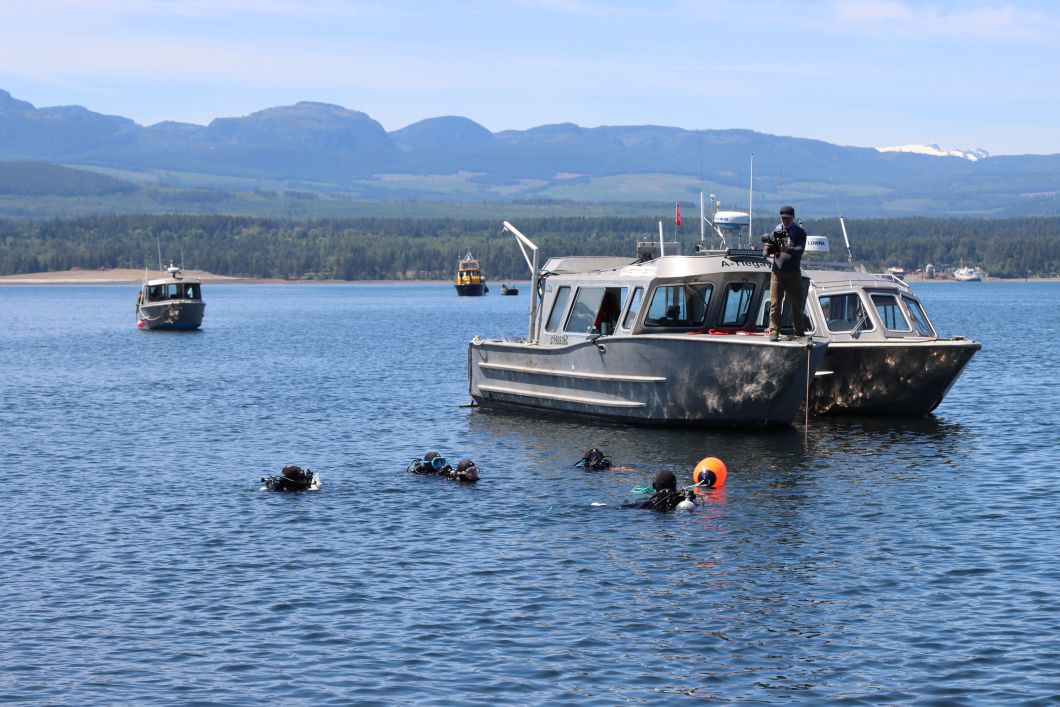
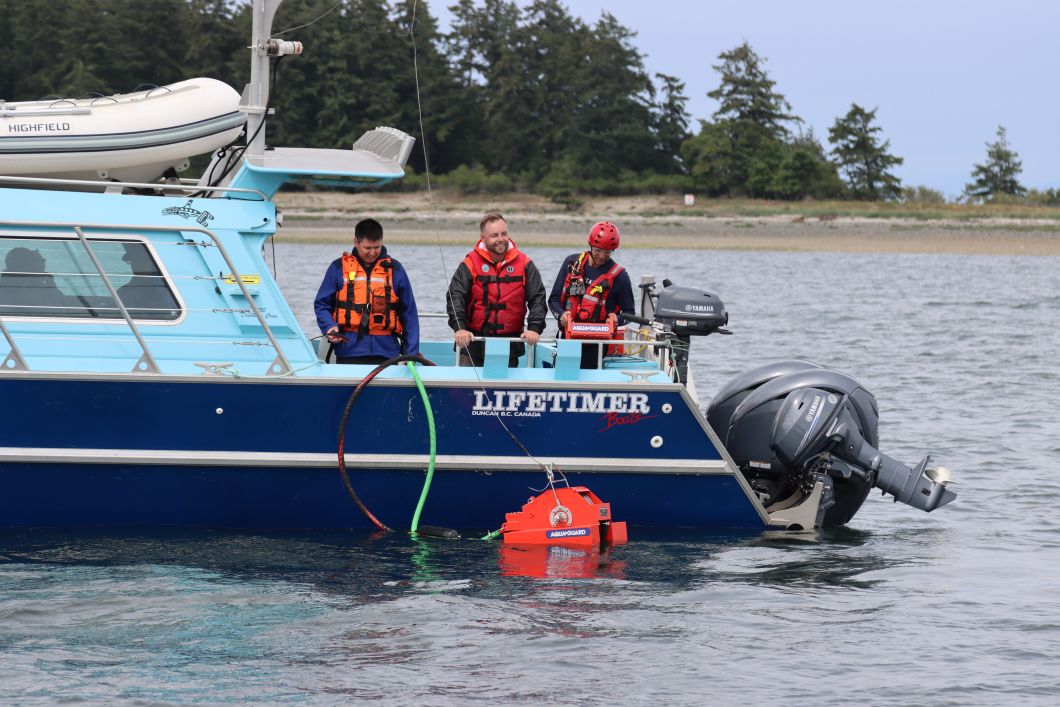
The first scenario, a sunken vessel and marine search and rescue, involved the deployment of drone and remote underwater vehicle equipment, a five-person diving team, scene surveying, patient recovery, and first aid. The second scenario involved an oil spill response with boom and skimmer deployment, and foreshore surveying.
Guardians demonstrated strong marine response protocols – just as they have done in real scenarios – practiced safe equipment deployment, problem-solving skills, and emergency response expertise.
The Guardians participating in the marine response exercise are part of the Ha-ma-yas Stewardship Network that strengthens and supports Nation-run Guardian programs. Ha-ma-yas, supported by Na̲nwak̲olas, delivers training for Guardians, raises funds for Guardians’ wages and equipment, and provides data storage, information sharing, cost-shared expertise (i.e. marine planning, GIS analysis), and other technical support.
For Guardians, emergency response training extends beyond deploying equipment and following protocols. It also requires a deep understanding of the places they are working to protect. This Guardian Gathering provided an opportunity to put marine response skills into practice, while drawing on generations of knowledge about their lands and waters. By combining technical expertise with cultural knowledge, Guardians can better assess potential impacts to sensitive ecosystems and culturally significant areas, ensuring response efforts are informed by stewardship, Traditional Knowledge, and Western science.
Lessons From a Living Breadbasket
While the Spring Guardian Gathering fostered Nation-to–Nation and intergovernmental teamwork, it was also a chance for Guardians to provide culturally and environmentally informed knowledge – exercising their skills that have been passed down for generations.
Across from the Goose Spit jetty, Guardians and Knowledge Holders walked along the shoreline of Jáji7em and Kw’ulh Sandy Island Marine Park, leading the cultural assessment portion of the emergency response scenario.
“This is a very protected area, and it’s very important that we [continue] to protect this area,” said Trevor Hardy, a K’ómoks’ carver who visited Jáji7em and Kw’ulh regularly as a child. “It’s a welcoming space, it’s untouched and it hasn’t been changed for so long. You look at the trees and think, ‘You are here. You’ve always been here. You have seen things and you know things we don’t know.’”
Running emergency response scenarios, like a hypothetical oil spill, is an essential part of protecting Jáji7em and Kw’ulh. With training, Guardians and Knowledge Holders can assess the shoreline and immediately spot inconsistencies in ecosystem health and abundance.
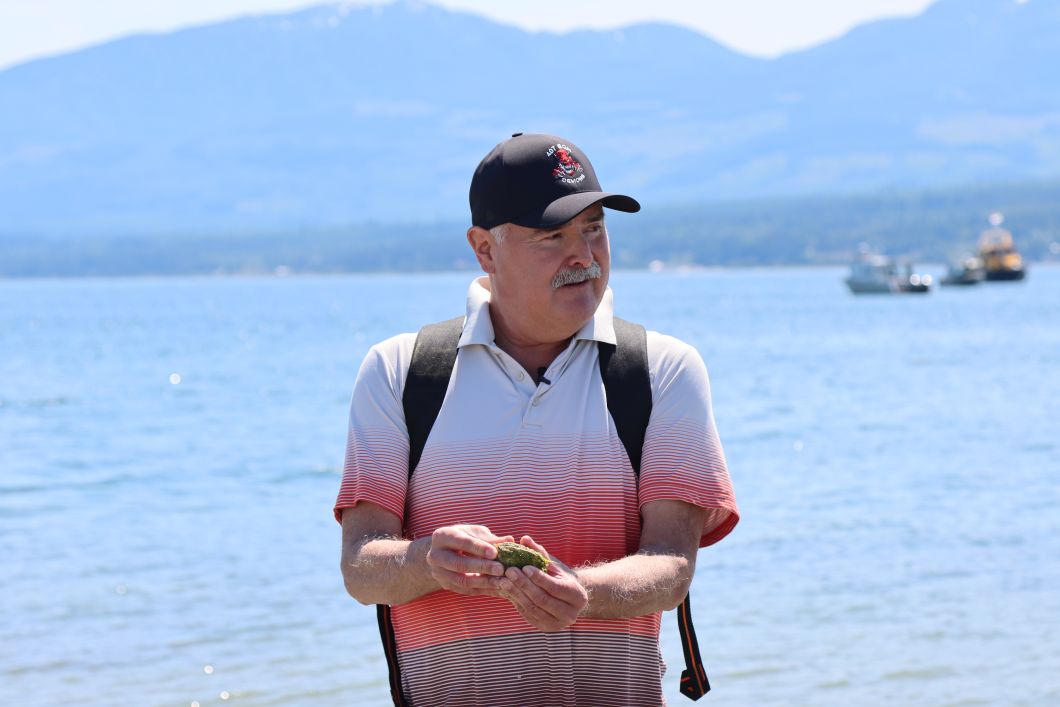
“An oil spill would directly impact shellfish, seabirds, and grasses,” said Trevor. Marine oil spills can cause adverse and long-lasting damage to wildlife, habitats, local communities, and the economy. When Guardians monitor the health of the coast, they’re also searching for signs of a healthy ecosystem that can sustain people and place, explains Namugwis Richard Hardy.
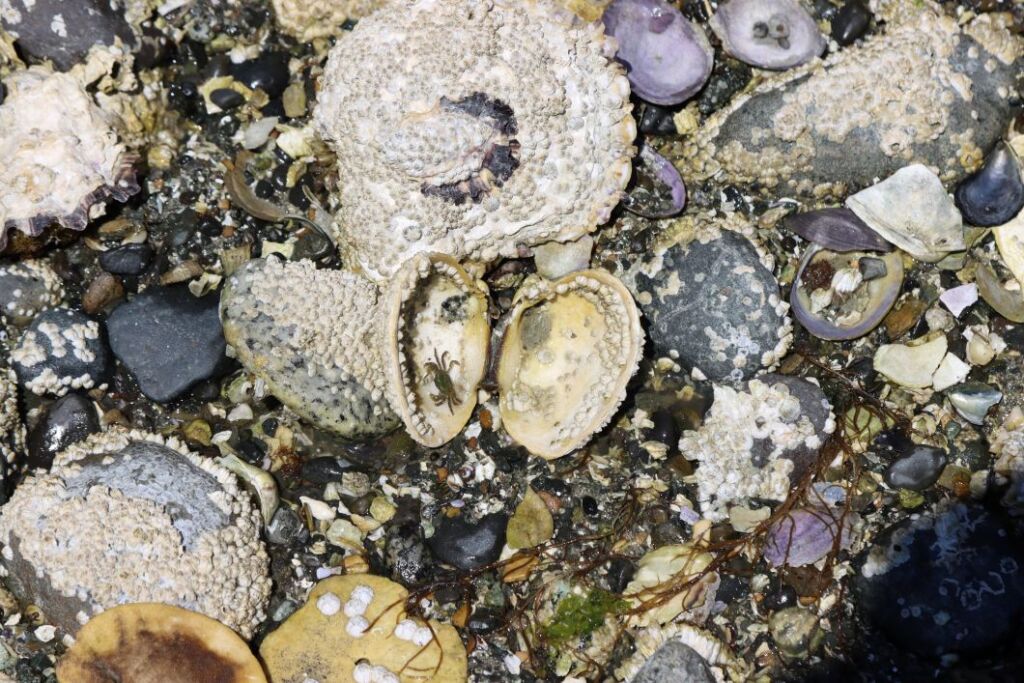
“When you see lots of barnacles on rocks and clams, that’s a sign that the ecosystem is healthy here,” said Richard. “If the barnacles are happy, everyone is happy.”
From an early age, Richard grew up digging for clams around Jáji7em with his father. “My old man would throw an anchor and head out to the clam gardens, and you would learn where he was digging.” By observing his father, Richard learned when to harvest clams and when to leave them untouched, understanding that maintaining the ecosystem depends on striking a careful balance. “Just being acquainted and being here all the time helps, too. I have that knowledge that can be shared.”
For K’ómoks First Nation, which is made up of several tribes with kinship and relations to Kwakwa̱ka̱ʼwakw, Coast Salish, and Nuu-chah-nulth peoples, knowledge sharing is an integral part of their rich cultural traditions. Jáji7em and Kw’ulh, Richard explains, is a “breadbasket and an area of spiritual and cultural significance” to K’ómoks people. It is also an important meeting place for trade and cultural exchange with neighbouring Nations.
If the barnacles are happy, everyone is happy.
Even today, said Richard, “you will hear people singing out at the end of [Jáji7em] Tree Island. From a spiritual and cultural perspective, something resonates with them – not just for us, but other Indigenous people who visit.”
Walking the shoreline with K’ómoks Knowledge Holders and Guardians illustrates why Goose Spit, Jáji7em, and Kw’ulh provided an ideal setting for the Spring Guardian Gathering. The area offered Guardians the opportunity to apply marine response skills in a place of profound ecological, cultural, and historical significance, demonstrating that emergency preparedness and stewardship are deeply connected.
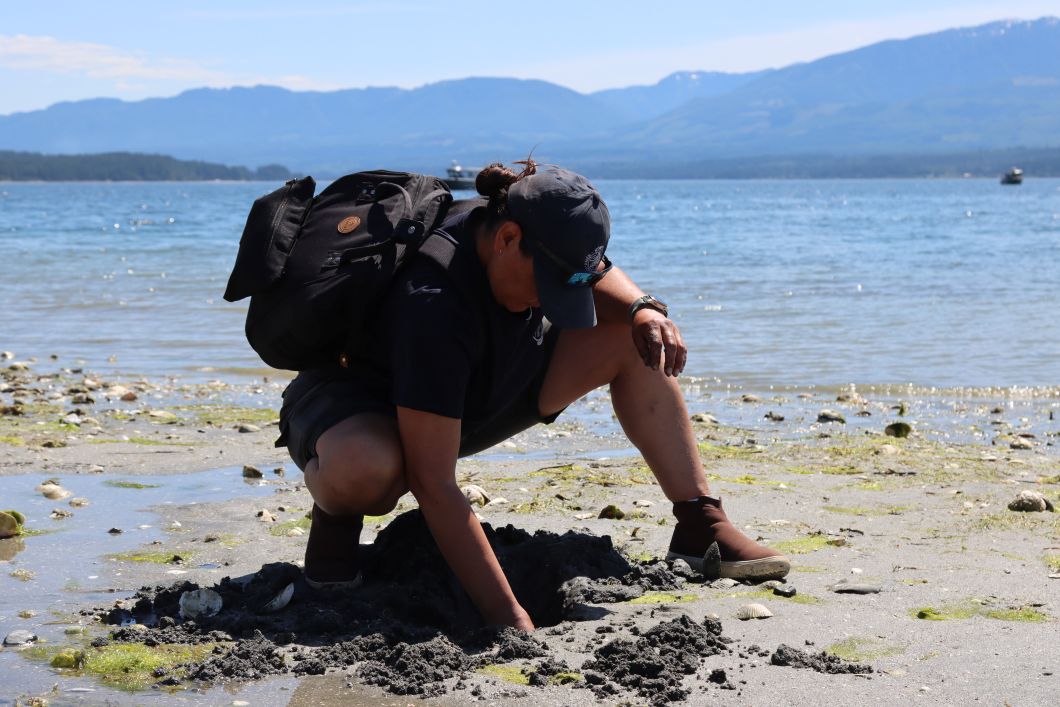
On the shoreline walk, K’ómoks Guardian Watchmen Manager, Krissy Brown, spotted bubbles in the sand and stopped to dig for a clam. Like Trevor and Richard, Krissy has spent many days and nights on Jáji7em and Kw’ulh. “You feel grounded in this space,” she said. “A lot of knowledge from generation to generation has been passed down, and we use that to make sure we monitor everything.”
Krissy digs about 20 centimetres deep and finds a clam to present to the shoreline team. The clam is healthy in size – about the width of a palm and heavy in the hand. A few minutes later, Krissy gently placed the clam back in its hole, carefully covering it with sand and patting down the surface to restore the beach as she found it.
“When I’m here, I feel like I can reach for the stars. I can feel my ancestors.” Krissy stood up and looked over the sandy bank of Jáji7em. “I feel that I can speak from my heart here.”
Using their investments with the Coast Conservation Endowment Fund Foundation, Na̲nwak̲olas member First Nations operate Guardian and monitoring programs and contribute to the Ha-ma-yas Stewardship Network.